Delivery Cost Per Mile: What it is and why every Fleet Manager should track It

Table of contents
For fleet and logistics managers, the pressure to cut costs without cutting corners is constant. Yet one of the most powerful metrics for doing exactly that, delivery Cost Per Mile (CPM), is still widely underused.
CPM tells you the true cost of moving goods from A to B. Not an estimate, not a rough figure, but a precise number built from every fixed and variable expense your fleet incurs. Whether you’re running five vehicles or five hundred, tracking it gives you sharper control over budgets, better visibility of inefficiencies, and the data to make smarter operational decisions.
For UK fleet and logistics operations in particular, where fuel costs, insurance premiums, and regulatory pressures continue to rise, that visibility has never been more important.
This article breaks down what cost per mile is, how to calculate it accurately, and how leading delivery operations are using it to protect margins and plan with confidence.
What is Cost Per Mile?
Cost per mile refers to the total cost a business incurs to operate a vehicle for every mile it travels. It’s one of the most fundamental metrics for fleet-based operations, yet often one of the most overlooked.
When calculated correctly, CPM provides a clear picture of both fixed and variable costs associated with fleet operations. This visibility enables logistics managers to understand where money is going, identify inefficiencies, and plan with greater accuracy.
Breaking Down the Components of Delivery Cost Per Mile

To calculate CPM accurately, you need to account for every expense involved in running your fleet. These typically fall into two categories.
Fixed costs remain constant regardless of how many miles your vehicles cover:
- Vehicle depreciation
- Insurance premiums
- Road tax and licensing fees
- Lease or finance payments
- Salaried driver and admin staff costs
Variable costs fluctuate based on mileage and delivery activity:
- Fuel
- Tyre wear
- Maintenance and repairs
- Toll and parking charges
- Pay for hourly or per-drop drivers
Once you have both figures, the formula is straightforward:
CPM = (Total Fixed Costs + Total Variable Costs) / Total Miles Driven
Worked example
Say your fleet’s total monthly fixed costs come to £8,000 (depreciation, insurance, leasing) and your variable costs for the same period are £12,000 (fuel, maintenance, driver pay). Your fleet covers 25,000 miles that month.
£8,000 + £12,000 = £20,000 total costs £20,000 / 25,000 miles = £0.80 per mile
That figure becomes your baseline. Track it month on month and you’ll quickly see whether operational changes, a new route, a vehicle swap, a fuel card deal, are actually moving the needle.
Calculate your fleet’s Cost Per Mile
Fixed costs (monthly)
Variable costs (monthly)
Total fixed costs
£8,000
Total variable costs
£7,450
Your cost per mile
£0.62
Based on your fleet’s total monthly costs divided by total miles driven.
What’s a typical CPM for UK fleets?
There’s no single benchmark that fits every operation, but many UK logistics businesses running mixed diesel fleets aim for a CPM somewhere between £0.70 and £1.20, depending on vehicle size, geography, and delivery density. Urban last-mile operations often sit toward the higher end due to stop-start driving, parking costs, and higher labour intensity per drop.
If your CPM is creeping above your sector norm, the sections below will help you identify where the pressure is coming from.
Why delivery Cost Per Mile matters for fleet operations

Tracking CPM isn’t just an accounting exercise. It’s one of the clearest signals you have about the health of your delivery operation. Here’s what it actually enables:
Benchmarking and budgeting Without a reliable CPM figure, fleet budgets are built on estimates. With it, you can benchmark performance across individual vehicles, depots, or regions, spot where costs are drifting, and build forecasts grounded in real operational data rather than last year’s best guess.
Fleet optimisation – Not all vehicles in a fleet perform equally. A higher CPM on a specific vehicle might point to ageing tyres, poor fuel economy, or a route that punishes it disproportionately. Identifying those outliers early means you can intervene before a maintenance issue becomes a breakdown, or retire an asset before it becomes a liability.
Competitive pricing – If you don’t know what a delivery actually costs you per mile, you’re pricing blind. Businesses that track CPM can set delivery charges that cover their true costs, stay competitive in the market, and protect margin, rather than discovering too late that certain contracts are running at a loss.
Profitability analysis – In delivery-led businesses, CPM is often a more useful profitability indicator than headline revenue. A contract that looks healthy on paper can quietly erode margin if the routes are long, the loads are light, or the vehicles are inefficient. CPM makes that visible before it becomes a problem.
Sustainability and ESG reporting – Lower CPM and lower emissions tend to go hand in hand. Reducing unnecessary mileage, cutting idle time, and improving route density all bring down fuel consumption alongside costs. For businesses with ESG commitments or carbon reduction targets, CPM data provides a practical operational foundation for reporting progress.
Industry Benchmarks: what is the average delivery Cost Per Mile in the UK?

There is no single CPM figure that applies across the board, and any source that offers one should be treated with caution. The reality is that average delivery cost per mile varies significantly depending on a range of factors, and understanding what drives that variation is more useful than chasing a headline number.
The key variables that influence where your CPM lands include:
Vehicle type and age – Larger vehicles cost more to run per mile in absolute terms, but may deliver a lower CPM when load capacity is fully utilised. Older vehicles tend to carry higher maintenance costs that push CPM up over time.
Fuel type – Diesel fleets face ongoing exposure to pump price volatility. Electric vehicles carry higher upfront costs but typically lower variable costs per mile, particularly for urban operations with predictable daily ranges.
Geography and route density – Urban last-mile operations often cover fewer miles per shift but face higher labour intensity, more stops, and parking costs. Long-haul and inter-depot routes benefit from motorway efficiency but carry greater fuel exposure over distance.
Delivery frequency and load efficiency – A vehicle running at full capacity on an optimised route will always produce a lower CPM than one running half-empty or doubling back. Load planning and route density are two of the biggest levers available to any fleet manager looking to bring CPM down.
Rather than benchmarking against an industry average, the more productive exercise is to establish your own CPM baseline, track it consistently, and measure it against your own historical performance. That internal benchmark is far more actionable than any external figure, because it reflects your actual cost structure, your routes, and your operation.
Using Cost Per Mile to improve delivery operations

Calculating your delivery cost per mile is straightforward. The harder and more valuable work is using it to drive consistent operational improvements. Here’s how logistics and delivery managers are putting CPM data to practical use:
Dynamic route planning – Not all routes are created equal, and CPM data makes the differences visible. By comparing CPM across routes, regions, and time periods, managers can identify which journeys are consistently more expensive than others and why. That insight feeds directly into dynamic route planning, allowing teams to rebalance workloads, consolidate drops, and reduce dead mileage without compromising delivery timelines or customer service levels.
Fleet maintenance strategy – A vehicle with a rising CPM is often trying to tell you something. Poor fuel economy, increasing repair frequency, or ageing tyres all push variable costs up before they become obvious operational problems. Tracking CPM at individual vehicle level gives you an early warning system, allowing for pre-emptive maintenance or targeted asset replacement decisions before a breakdown forces your hand.
Driver performance monitoring – Driver behaviour has a measurable impact on both fuel consumption and vehicle wear. Harsh acceleration, excessive idling, and inefficient speed profiles all contribute to a higher CPM. When CPM data is analysed alongside telematics, it becomes possible to identify which drivers would benefit from additional training and which are already operating efficiently enough to be recognised and rewarded.
Demand forecasting and resource allocation – If certain delivery windows, customer segments, or geographic areas consistently produce a higher CPM, that’s a signal worth acting on. It might mean rethinking how resources are allocated across those runs, introducing minimum order values to improve load efficiency, or adjusting pricing to reflect the true cost of serving those customers. CPM turns what would otherwise be a vague sense that “some deliveries cost more” into a specific, quantifiable case for change.
How Route Optimisation software supports lower CPM
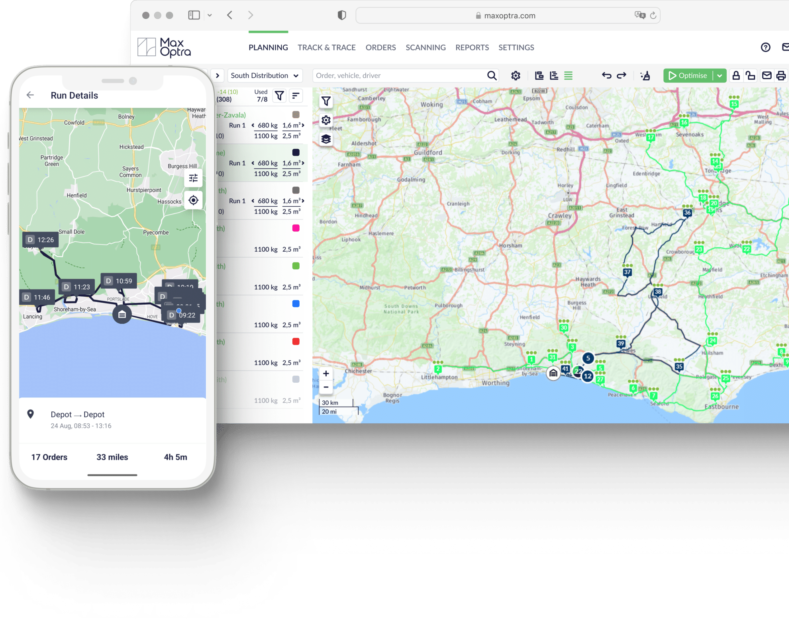
Knowing your CPM is the first step. Reducing it is where route optimisation software earns its place.
MaxOptra helps delivery and logistics businesses cut the variable costs that drive CPM up, by intelligently planning routes that reduce total mileage, improve delivery drop density, and limit unnecessary idle time. The result is less fuel burned, less wear on vehicles, and fewer miles driven per drop.
The impact shows up in real numbers. Hobsons Brewery, an independent regional brewer managing regular customer deliveries across a mixed fleet, saw a 7% reduction in delivery costs after implementing MaxOptra to optimise their routes. That improvement came directly from tighter, more efficient routing, exactly the kind of gain that compounds over time as mileage falls and variable costs follow.
Beyond route planning, MaxOptra integrates with telematics systems and provides automated reporting, giving fleet managers the data they need to monitor CPM trends, identify problem vehicles or routes, and act before costs escalate. The visibility the platform provides turns CPM from a monthly retrospective figure into an active management tool.
For operations looking to bring CPM down consistently, the combination of smarter routing and real-time data is hard to beat.
Final thoughts
Cost per mile isn’t just a number, it’s a strategic tool. For delivery and logistics businesses, understanding CPM means gaining control over the single largest operational cost: transportation. And in an industry where margins are often razor-thin, that insight is invaluable.
By breaking down fixed and variable costs, analysing trends, and implementing optimisation strategies, fleet managers can make smarter decisions that improve both efficiency and profitability.
Ready to reduce your Cost Per Mile?
Want to understand how your delivery operations stack up? MaxOptra’s route optimisation software helps logistics teams cut mileage, fuel usage, and delivery time – all contributing to a lower cost per mile.
Get in touch with us to see how we can support your goals.
FAQs: Cost Per Mile in Delivery and Logistics
What is a good cost per mile for delivery fleets?
A “good” CPM varies depending on your location, delivery model, and vehicle type. In the UK, many logistics operations aim for a CPM under £1.00, but high-efficiency fleets using electric vehicles or optimised routing may go lower.
How often should I calculate cost per mile?
It’s best practice to review CPM monthly or quarterly. However, in high-volume operations, weekly tracking can help spot trends and inefficiencies sooner.
What can increase my cost per mile unexpectedly?
Unexpected factors include fuel price surges, vehicle downtime, poorly optimised routes, and delays due to traffic or weather. Monitoring these alongside CPM can help you react quickly.
How does cost per mile differ for last-mile delivery versus long-haul?
Last-mile delivery often has a lower mileage per delivery but higher stop frequency and labour costs, leading to a different CPM structure. Long-haul deliveries generally have higher fuel costs but benefit from route efficiency over distance.
Can software really help reduce my CPM?
Yes. Route optimisation, telematics integration, and real-time scheduling can significantly reduce wasted mileage, fuel costs, and delays – resulting in a lower overall CPM.
Maxoptra System
© MaxOptra, 2023. Privacy Policy and Cookies